
Most people don’t struggle with “style.” They struggle with getting dressed when real life is loud: work, errands, weather, comfort, laundry, body changes, and that constant feeling that you should look nicer than you have time for.
Intentional everyday style is not about having more outfits. It’s about having fewer decisions. You want a small set of choices that reliably make you feel like yourself, look put-together, and still let you move through your day comfortably.
This pillar is built around repeatability. You’ll create a few outfit formulas, a color lane, and a “finishing” habit that makes basics feel deliberate. You’ll still wear the same jeans and tees. You’ll just wear them in a way that looks like you meant it.
Also, clothes genuinely can influence how you feel and perform, partly through their symbolic meaning and the experience of wearing them (this is often discussed under “enclothed cognition”).
Quick answer for skimmers
- Intentional style is 80 percent repeatable formulas, 20 percent “fun pieces.”
- Pick a style anchor (one word) and a color lane (2 neutrals + 1 accent).
- Build 3 everyday outfit formulas you can wear on autopilot.
- Use the “third piece” trick: add one layer that creates structure (overshirt, cardigan, blazer, trench).
- Make comfort part of the aesthetic: choose fabrics and cuts you actually want to live in.
- Stop trying to fix everything at once. Fix your biggest bottleneck first: shoes, outer layer, bras, or bottoms.
- Use a micro-habit: “If I get dressed, then I add one finishing touch.”
- Your closet should match your real week, not your fantasy week.
If you only do one thing:
Choose one default formula you genuinely like (top + bottom + third piece) and make 2–3 versions of it. That’s how you look consistent without thinking.
What “intentional” looks like in real life
People read “intentional” when they see a few signals:
- The outfit has a clear shape (not all tight, not all sloppy)
- The colors look like they belong together
- The shoes don’t fight the outfit
- There’s one small “finish” (earrings, belt, tidy hair, a lipstick, a watch)
- The outfit fits your day (you look comfortable, not like you’re pretending)
Notice what’s missing: novelty. You don’t need new outfits constantly. You need outfits that work.
The real problem is decision load
When you’re tired or rushed, even small choices feel heavy. “Decision fatigue” gets talked about a lot, but the research around ego depletion and depleted willpower is mixed and debated.
You don’t need to prove a psychology theory to benefit from a simpler closet. If fewer options makes mornings easier, that’s enough.
The decision framework: comfort, aesthetics, real life
Here’s the simplest way I know to stop overthinking:
1) Pick your Style Anchor (identity)
One word that describes how you want to feel this season:
- Clean
- Soft
- Sporty
- Classic
- Minimal
- Artsy
- Bold
- Romantic
This is your north star. It prevents drift.
2) Pick your Real-Life Requirements (function)
Answer these quickly:
- Do you sit, walk, or stand most of the day?
- Do you need pockets?
- Do you need to move fast, bend, lift, commute?
- Do you need outfits that work for weather shifts?
- Do you need “camera-ready” sometimes?
Your wardrobe has to respect your day. That’s not boring. That’s smart.
3) Pick your Comfort Non-Negotiables (fit)
Your personal dealbreakers, like:
- no pinching waistbands
- no scratchy fabrics
- shoes must handle X steps
- tops must allow arm movement
- bras must be comfortable for long wear
If you ignore these, you’ll keep buying “nice” clothes you don’t wear.
This won’t work if you build outfits around items you secretly hate wearing. If the blazer feels like a costume, it’ll stay on the chair. Choose the version of polished that still feels like you.
Step 1: Create a Color Lane that makes mixing effortless
If you want repeatability, color is your best friend. It’s the easiest way to make basics look cohesive.
The simple color lane
- 2 neutrals you love wearing (examples: black + cream, navy + gray, brown + ivory)
- 1 accent color you enjoy (examples: olive, burgundy, cobalt, soft pink)
That’s it.
This makes your wardrobe mixable without you “trying.” It also makes repeats look intentional because the palette is consistent.
Tip that actually helps: take a photo of your favorite outfit and look at the colors. Your closet is already telling you what you like.
Step 2: Build 3 outfit formulas you can repeat forever
Formulas are what stylish people lean on when life is busy. You’re not copying someone else’s style. You’re building your own autopilot.
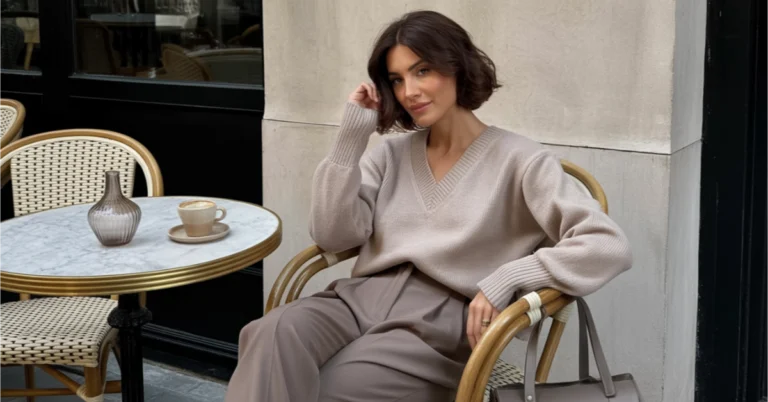
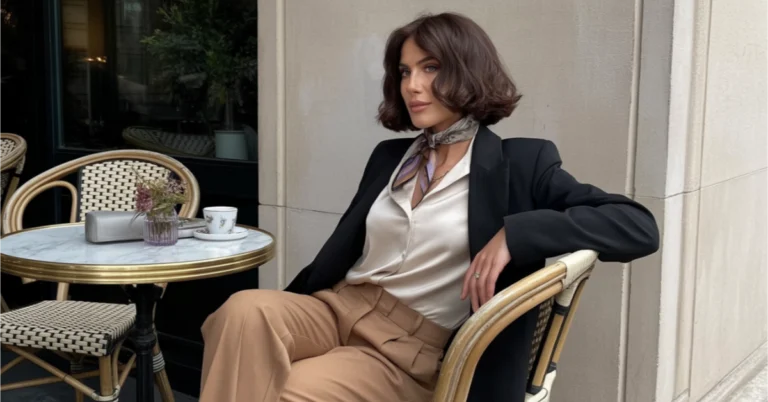
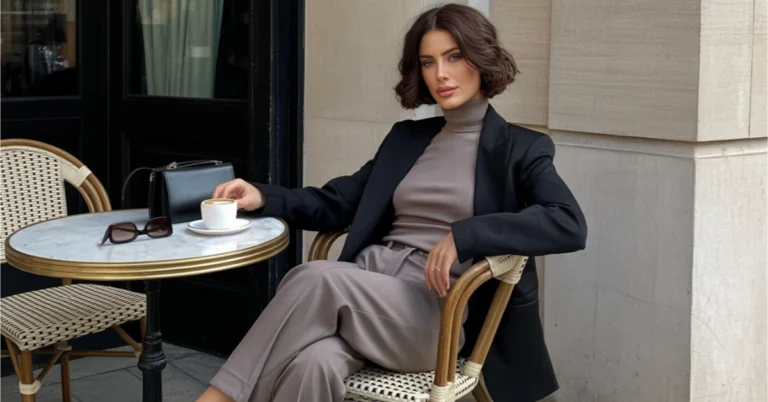
Formula A: Straight pants + fitted-ish top + third piece
- Straight jeans or tailored pants
- Tee, tank, knit top, or slim sweater
- Overshirt, cardigan, blazer, trench
- Sneaker, loafer, ankle boot
Why it works: the third piece adds structure and makes the outfit look “planned.”
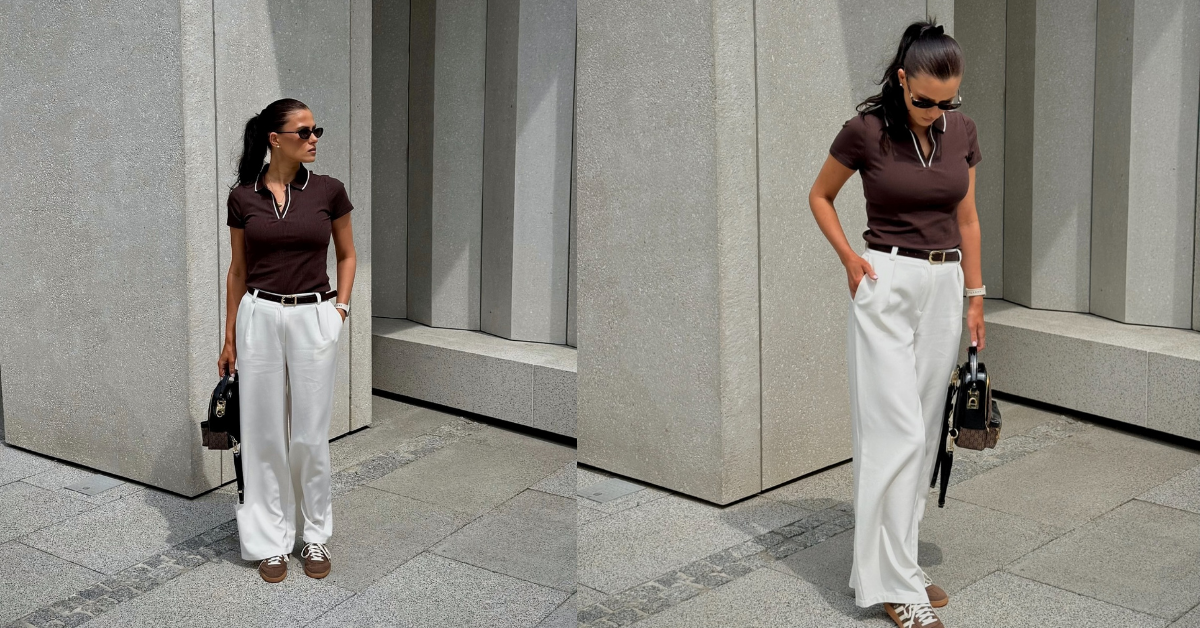
Formula B: Wide pants + simple top + contained shoe
- Wide-leg trousers or relaxed denim
- Simple top with a clean neckline
- Shoe that feels intentional (sleek sneaker, loafer, clog, boot)
Why it works: wide pants look elevated even with a basic top.
Formula C: One-piece outfit + layer
- Midi dress or jumpsuit
- Jacket, denim layer, cardigan
- Bag that matches your real life (crossbody, tote)
Why it works: one-piece outfits remove a major decision.
Now choose one of these as your “default.” Not the most fashionable one. The one you’d wear on a random Tuesday.
Step 3: Make repeat outfits look intentional, not repetitive
Repeating is the goal. But you want it to feel like a choice, not a rut.
Use these three levers:
Lever 1: Change the third piece
Same jeans and tee, different layer:
- denim jacket
- cardigan
- blazer-ish knit jacket
- trench
- flannel overshirt
Lever 2: Change the shoe
Shoes shift the whole vibe fast:
- clean sneaker = modern casual
- loafer = polished
- boot = grounded, slightly edgy
- sandal = effortless
Lever 3: Add one “finish”
Pick one:
- small hoop earrings
- a watch
- a belt
- a lipstick
- a structured bag
Small finishes are how basics stop looking like “I gave up.”
Step 4: The repeatability habit that makes this stick
This is where people fall off: they try to “be stylish” through motivation. Motivation is unreliable. Systems win.
Habit research shows the time it takes for habits to feel automatic varies widely, but repetition in a stable context matters.
Classic research on everyday habits found a median around 66 days for a habit to reach near-automaticity, with big individual variation.
So instead of trying to overhaul everything, build one tiny “if-then” plan.
The easiest style if-then
“If I get dressed, then I add one finishing touch.”
Implementation intentions (if-then plans) are a well-studied strategy for making behaviors more consistent.
This is optional. Skip it if habits make you feel boxed in. But if you like structure, it’s a cheat code.
Step 5: Comfort that still looks good (without sacrificing your taste)
Comfort does not have to mean sloppy. Most of the difference is fabric, fit, and proportion.
Comfort fabrics that look intentional
- Ponte knit (holds shape, feels soft)
- Rib knits (stretchy, looks sleek)
- Cotton poplin (crisp, breathable)
- Structured jersey (doesn’t cling as much)
- Denim with stretch (but not ultra-thin)
The proportion trick
If one part is loose, make one part more defined:
- wide pants + closer top
- oversized top + straight pants
- leggings + longline top + structured layer
It’s not a rule. It’s a shortcut when your brain is tired.
Step 6: The “bottleneck” method for upgrading your everyday style
If you’re tempted to buy random cute pieces, pause and find your bottleneck. This is what actually stops you from wearing outfits you like.
Common bottlenecks:
- You have clothes, but shoes hurt
- You have tops, but no bras that work
- You have basics, but no third pieces
- You have outfits, but no bag that fits your life
- You have great pieces, but nothing fits right now
Fix the bottleneck first. One fix can unlock 10 outfits.
A very real trade-off (with no perfect solution)
A smaller, more repeatable wardrobe makes mornings easier. But if variety and novelty are core needs for you, repetition can feel boring. You can reduce that feeling with accessories and seasonal switches, but you might still want a few extra “fun” items. There’s no single right answer.
The “Intentional Everyday” mini wardrobe (not a strict capsule)
Capsule wardrobes get talked about a lot in fashion media, including the popular 30–37 items approach associated with Un-Fancy.
The broader idea was also popularized in fashion history through Donna Karan and her “Seven Easy Pieces” concept.
You don’t need a strict number. You need a functional set that matches your week.
Here’s a flexible “mini wardrobe” that creates repeat outfits:
- 2 bottoms you love (jeans + trouser or skirt)
- 3 tops (tee, nicer top, knit)
- 2 third pieces (cardigan/overshirt + jacket/coat)
- 1 one-piece (dress or jumpsuit) if that’s your style
- 2 shoes (sneaker + upgrade shoe)
- 1 bag (hands-free or work-ready)
- 1 finishing accessory lane (earrings, watch, belt)
That’s enough for a strong everyday rotation.
Common mistakes that cause overthinking
Mistake 1: Trying to create “new outfits” every day
Repeat outfits on purpose. Consistency is a style.
Mistake 2: Copying someone else’s aesthetic without your real-life filter
If it looks great on Pinterest but doesn’t work for your day, it won’t become your style.
Mistake 3: Buying statement pieces without basics that support them
Statements need a foundation. Otherwise they feel like costumes.
Mistake 4: Ignoring the emotional data
If you avoid an item every time it’s clean, it’s not for your life. It’s for your fantasy self.
Variations by lifestyle
If you want comfort-first but not “lazy”
- Matching knit set + trench or structured cardigan
- Clean sneaker or loafer
- Simple earrings
If you want polished but not fussy
- Straight pants + knit top + blazer-ish layer
- Minimal jewelry
- One good shoe
If you live in athleisure
- Leggings + longer top + structured third piece
- Keep the palette consistent
- Upgrade the shoe (clean sneaker, not beaters)
If you want more personality
- Keep the formula basic
- Put personality into one lane: color, jewelry, print, or shoes
- Limit it to one lane so it still feels intentional
If your life is unpredictable
If your mornings are chaotic, some of this prep won’t stick, and that’s fine. The goal isn’t perfection, it’s fewer “I hate everything” moments.
FAQ
How do I find my personal style again?
Start with what you actually wear on your best normal days. Name the pattern (colors, silhouettes, shoes), then build around it.
What’s the fastest way to look more intentional?
Add one third piece and one finishing touch. That’s it.
How many outfits should I aim for?
Aim for 10–15 outfits you can rotate without thinking. Not 50 options that stress you out.
Do clothes really affect how you feel?
They can. Research on enclothed cognition suggests clothing can influence psychological processes when the clothing’s symbolic meaning and the act of wearing it align.
How do I stop shopping as a “solution”?
Fix bottlenecks first. Then set a rule: no new items unless they complete at least 3 outfits with what you already own.
What if I love fashion and don’t want a simplified wardrobe?
Then don’t go minimalist. Keep your variety, but still use formulas and color lanes so you’re not starting from zero every morning.
Just a little note - some of the links on here may be affiliate links, which means I might earn a small commission if you decide to shop through them (at no extra cost to you!). I only post content which I'm truly enthusiastic about and would suggest to others.
And as you know, I seriously love seeing your takes on the looks and ideas on here - that means the world to me! If you recreate something, please share it here in the comments or feel free to send me a pic. I'm always excited to meet y'all! ✨🤍
Xoxo Lara